Building a Shortlist from an NSFW AI Ranking Page
A ranking page is a starting point, not an answer sheet, and the fastest way to use one is to turn it into a five-name shortlist in three passes of about ten minutes each. The chart itself is small — twenty entries, rebuilt every Thursday — so the work is filtering, not scrolling. A card reading of 0.0526% favourites against views looks strong until you notice that its neighbours read 0.0292% and 0.0175%.

Key takeaways
- Pass one filters by access label and cuts twenty entries to a working set; pass two samples three conversations; pass three keeps at most five names.
- The favourite-to-view ratio is the only counter worth comparing, and the observed readings sit between 0.0175% and 0.0526%.
- The chart is refreshed every Thursday, so a shortlist older than a week is describing a ranking that no longer exists.
- An illustrative ramp of three sessions in week one rising to eight or nine by week six reaches 34 cumulative sessions — enough to test a shortlist properly without marathon sessions.
Why a chart is a bad shopping list
Rank carries no information about fit. A page showing the best-performing entries tells you what a large group of visitors liked, and the top of that list will always be broader in appeal than the middle. If your taste is specific, the top three entries are the least likely part of the chart to match it.
Rank also carries a freshness problem. Twenty entries are reshuffled every Thursday, which means any capture older than seven days describes a different set of leaders. Two useful consequences follow: never build a shortlist from a screenshot, and never treat the current number one as a permanent landmark.
The counters have a narrower use. Each card pairs a view count with a favourite count, so you can compute a ratio and compare like with like instead of comparing raw reach. Crushon lists these readings on its NSFW AI characters page, and the ratio is the only one of the two numbers that survives a comparison across cards of different ages.
The three passes, in order
Pass one: filter, do not read. Set the access label that matches what you want — Unfiltered, Filtered or 18+ — and note how many entries survive. You are aiming for a working set of eight to ten names, which is small enough to sample and large enough to compare.
Pass two: sample three conversations. Open the three entries that interest you most and send a few messages to each. The goal is not to finish anything, it is to find out whether the opening context gives you something to respond to. Three samples of a few messages each are enough to tell a card with a written setup from a card with a name and a picture slot.
Pass three: keep five, drop the rest. Write down the name, the label combination and one sentence about why you kept it. Five entries is a list you can revisit; twenty is a list you will forget you made.
| Pass | Action | Target size | Stop signal |
|---|---|---|---|
| One | Apply an access label and a gender filter | 8 to 10 names | The grid fits on one screen |
| Two | Sample a few messages with three entries | 3 names | You can name the one you would return to |
| Three | Record name, labels and reason | 5 names | The notes read as decisions, not impressions |
| Weekly | Re-read the chart after Thursday | 2 or 3 additions | The list changes by a name or two at most |
Worked example: does a shortlist fit into a normal week?
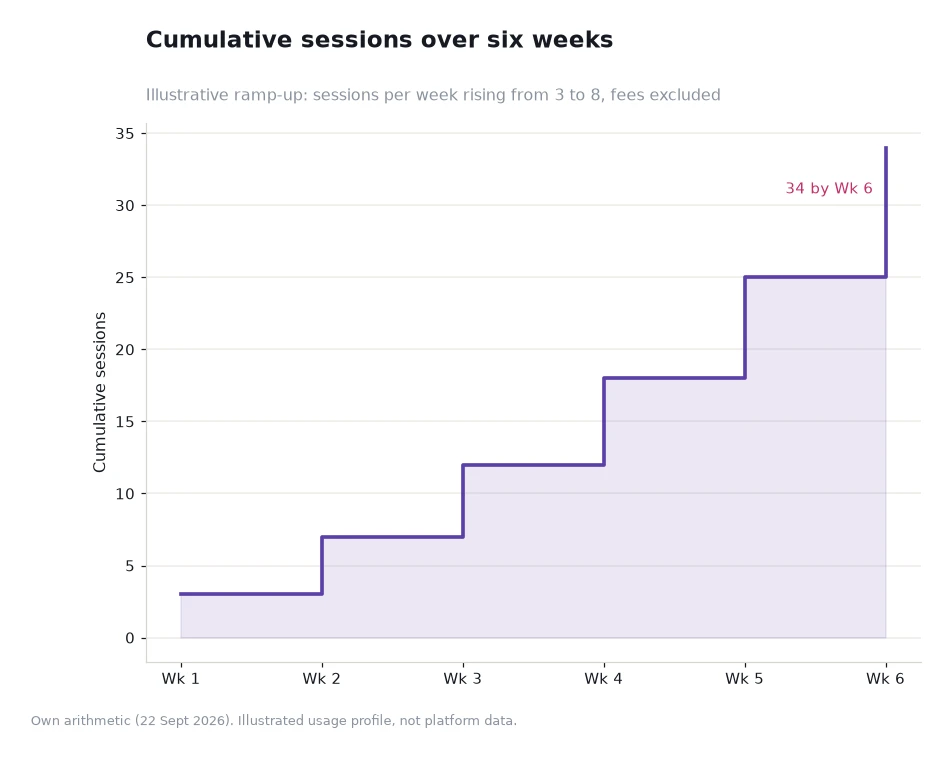
The illustration below assumes a gentle ramp rather than a fixed habit. Week one is three sessions, week two four, then five, six, seven and finally nine in week six: 3 + 4 + 5 + 6 + 7 + 9 = 34 cumulative sessions. Read down the cumulative line instead and you get 3, 7, 12, 18, 25 and 34.
Now allocate those 34 sessions to the three passes. If pass one takes one session, pass two takes three samples and pass three takes one review, the whole shortlist costs five sessions in week one, which the ramp covers with two to spare. The remaining sessions across the six weeks — 34 minus the 5 spent shortlisting, or 29 — are free for actually using the list you built.
The arithmetic is an illustrative assumption about a usage profile, not platform data, and the shape matters more than the totals: a shortlist built once and revisited weekly costs less time than reopening the chart every day. Six weeks is also long enough for the chart to have been rebuilt six times, which is the natural cadence for revisiting the list.
Where the shortlist approach pays off
The payoff is in re-entry. A named list of five entries with a note on each takes seconds to resume, while a fresh chart read takes a full pass every time. That is the practical difference between browsing and having a stable set of conversations to return to on the nsfw ai ranking page.
Keep the weekly rankings review short as well. After the Thursday refresh, look only for one or two additions, and only if an addition matches a label combination you already use. A list that grows every week is a list you have stopped curating. The character search view is the quickest place to confirm that a new name fits the labels you already rely on.
Creator continuity is the other shortcut worth knowing. A card's labels usually echo a house style, so if two entries you kept come from the same creator, a third from that name is a better next candidate than a random entry from the middle of the chart. Crushon lists Creators separately from Characters, which makes that check a single click rather than a hunt.
A final note on scope: a shortlist is a working set, not a collection. Five names you revisit weekly will outperform twenty names you never open twice, and the difference shows up inside the first month rather than the first year.
Frequently asked questions
How many entries should a shortlist hold?
Five. It is small enough to review in one sitting and large enough that dropping one does not empty the list.
Is a higher favourite-to-view ratio always better?
No. It shows that a larger share of visitors chose to save the card, which can reflect a narrow, well-described audience as easily as a well-written character. Compare it alongside the label set.
How often does the ranking change?
The twenty entries on the trends chart are refreshed every Thursday, so a weekly review matches the platform's own cadence.
Do I need an account to build the list?
Browsing the chart and the catalogue is the discovery step, and you can plan the list before you commit to anything. Crushon keeps Creators and Characters as separate lists, so a name found on one may be worth checking against the other.
Do it once, then maintain it
Build the list in a single sitting rather than over a week of drifting attention, because the comparison only works when the cards are seen close together. Then spend two minutes after each Thursday refresh deciding whether anything deserves to be added. Everything else on the chart is reference material, and reference material is worth reading without acting on.
Data and sources: trend card counters and the weekly chart on the Crushon trends page[1], read 22 Sept 2026; ratios and the six-week session ramp are own arithmetic and an illustrated assumption respectively. Intended for readers aged 18 or older.