A China procurement workflow needs clear owners for the decisions that change scope, price, quality, compliance, or delivery. The process becomes fragile when a supplier receives conflicting instructions or a verbal approval has no record of what it covered. Define who requests quotes, who approves technical evidence, who can accept a deviation, and who releases goods, then connect each decision to a versioned document and dated record.
Key takeaways
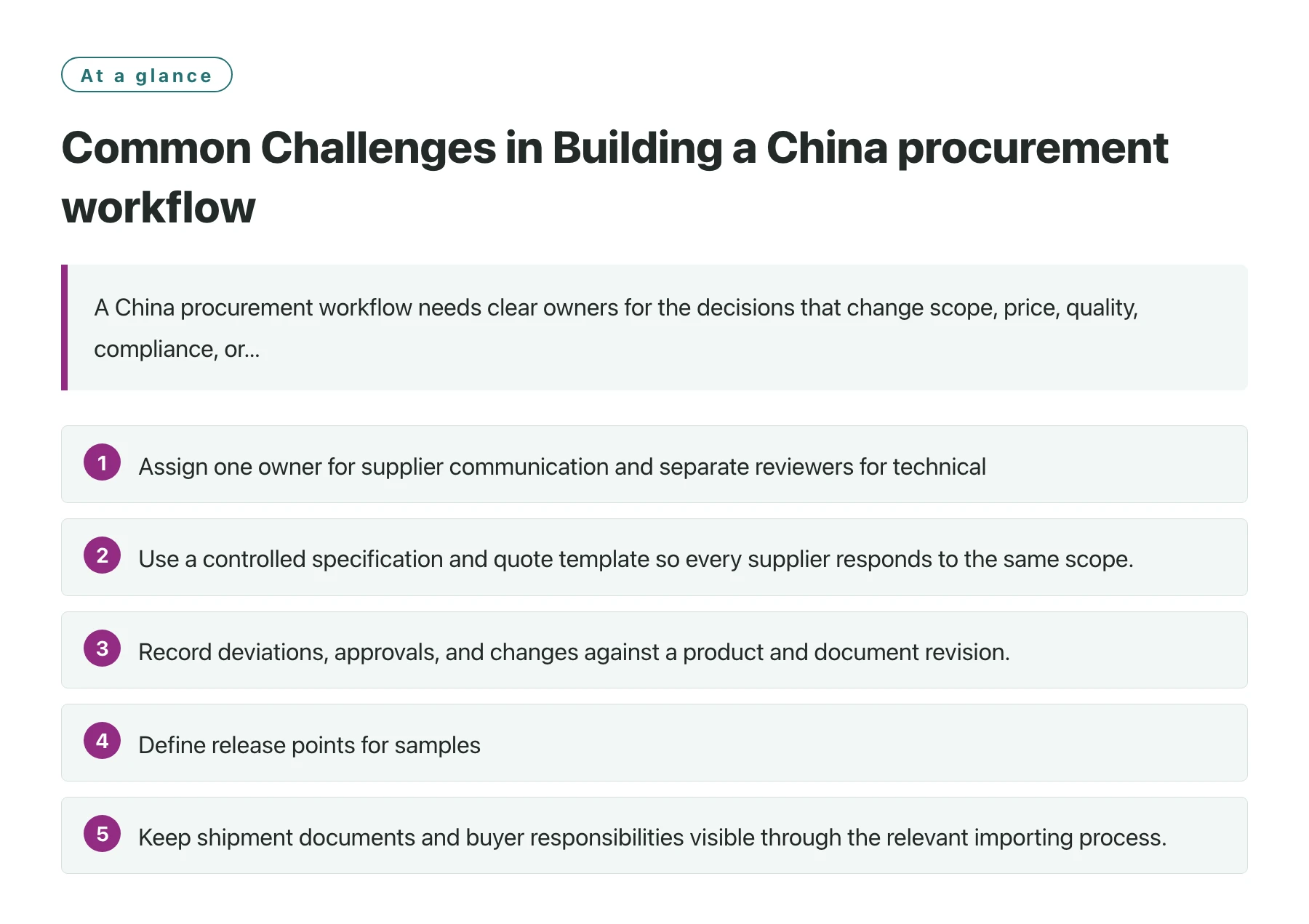
- Assign one owner for supplier communication and separate reviewers for technical, commercial, and regulatory decisions.
- Use a controlled specification and quote template so every supplier responds to the same scope.
- Record deviations, approvals, and changes against a product and document revision.
- Define release points for samples, production, inspection, shipment, and receipt with the evidence each requires.
- Keep shipment documents and buyer responsibilities visible through the relevant importing process.
- Review the workflow after delivery and update controls when a handoff or record repeatedly fails.
Procurement processes can be described as a sequence of stages, but the harder question is who has authority to move work from one stage to the next. A quote may be commercially attractive while technical details remain open; a sample may look right while documentation is incomplete; cargo may be booked while inspection has not released it. A written workflow gives the project team a shared answer for each of those decision points.
Name the owner and reviewer for each workstream
Create a responsibility map for the product or purchase category. Procurement can coordinate inquiries, quotations, and purchase terms; engineering or the product owner can approve fit and function; quality staff can define inspection and records; regulatory specialists can confirm market requirements; and logistics can arrange pickup, shipping, and receiving. One person may hold more than one role in a small team, but the decision responsibilities still need to be explicit.
Identify the person who may issue instructions to suppliers and the person who can approve a change. If several internal teams contact the same supplier independently, set a process for consolidating questions and sharing answers. A supplier should know which instruction is current and whether a message is a request for information, a proposal, or an approved change.
For external coordination support, define which tasks a a sourcing company in China will perform and which decisions remain with the buyer. The scope might cover communication, document collection, sample arrangements, or inspection scheduling, but the written agreement should state responsibilities, authority limits, and escalation paths.
Establish a single source of truth for product scope
Use a controlled specification, drawing set, or schedule for each product. Assign an identifier, owner, revision, issue date, and approval status. Attach reference samples or images where useful and label whether they are binding requirements or visual guidance. If an internal system stores the official version, link suppliers and project reviewers to it rather than distributing files with ambiguous names such as final-v3-new.
Ask every candidate to quote against the same revision and return deviations in a common format. Keep commercial assumptions, technical exceptions, and open questions in separate fields so a price discussion does not hide a product change. When clarification changes the scope, issue a new revision or add a dated response that clearly applies to the current one.
At order release, check that the purchase order, quotation, specifications, samples, and required documents refer to consistent product identifiers and quantities. If a supplier quote includes its own drawing or configuration code, map that code to the buyer's specification so later inspection can identify the correct item.
Use approval gates that match the risk
A gate is a documented condition that must be met before a commitment or release. Examples include approved product scope before tooling, accepted samples before production, required evidence before production release, inspection disposition before shipment, and receiving confirmation before closing the order. The exact gates should follow product risk and contractual obligations; avoid creating approvals that add delay without resolving a real uncertainty.
For every gate, name the approver, evidence required, deadline, and exception route. If an approver accepts a deviation, record the affected product, quantity, reason, and whether the acceptance is one-time. If evidence is incomplete, show the status as open rather than letting a project manager infer that silence means approval.
Separate commercial approval from technical acceptance. A buyer may agree to a price or schedule while engineering still needs to approve a drawing or test result. Similarly, receipt of a shipment does not automatically establish product acceptance unless the contract and inspection process say so.
Control changes without stopping useful communication
Suppliers need a way to raise proposed alternatives, schedule risks, and quality issues quickly. The workflow should encourage early notice while preventing informal messages from silently changing the order. Require a change request to identify the affected part, revision, quantity, reason, effect on fit or performance, cost, schedule, documentation, and evidence needed for review.
Set a response time and escalation route for urgent decisions. If a change can affect regulatory status, safety, installation, or product performance, route it to the qualified reviewer before approval. If it affects only a noncritical finish choice, a faster design review may be sufficient. Keep the risk and authority level proportional to the decision.
Maintain an audit trail of the request, decision, approver, date, and revised documents. Tell the supplier when an old drawing or instruction is superseded and ask them to confirm receipt of the new version. This makes it easier to explain why production used a particular configuration if a later question arises.
Make records useful at production and shipment time
A procurement record should help someone act, not just show that a form was completed. For sample approval, capture model, revision, test conditions, result, deviations, and next step. For inspection, record lot, sample source, method, findings, disposition, and release owner. For shipment, connect package marks and counts to the order, packing list, and receiving location.
For goods imported into the United States, Customs and Border Protection provides importer guidance about understanding import requirements and transaction records.[1] Importers should confirm their obligations for the product and transaction with the relevant authority or qualified broker. For other destination markets, identify the corresponding customs and regulatory contacts instead of reusing a U.S.-specific checklist.
Give the supplier and internal team only the records they need while keeping the master file complete. Use consistent identifiers across email subject lines, sample labels, reports, and purchase documents. If a product issue occurs, this structure can help the team locate the relevant lot and decision without reconstructing the project from multiple inboxes.
Review the workflow after delivery
After receipt, compare planned milestones with actual handoffs. Note whether specifications were clear, approvals arrived on time, document versions matched, inspection findings were resolved, and the receiving team could identify the goods. Keep observations specific: 'the package list used an old room code' is more actionable than 'communication was poor.'
Use the review to adjust role assignments, forms, or approval gates for the next order. Do not remove a control only because one order went smoothly; first consider whether the control prevented a problem or whether the product and risk were different. Retain the earlier workflow version with the project record so future staff understand which process governed the order.
Sources
Frequently asked questions
Who should communicate with the supplier?
Assign a communication owner who consolidates instructions and questions, while naming the technical, commercial, quality, and regulatory reviewers for their respective decisions.
Does a sourcing coordinator approve product compliance?
That depends on the written scope and qualifications. Regulatory classification and market-release decisions should stay with the responsible importer and qualified reviewers unless authority is explicitly and appropriately assigned.
How can a buyer prevent unapproved substitutions?
Require a documented change request that identifies the affected product and impact, name the approver, and keep production tied to the current approved revision.
What is a useful procurement workflow record?
A record should identify the product and revision, decision owner, evidence reviewed, result or exception, date, next action, and release status.