Most of what has changed in fragrance buying over recent years does not change what a factory does; it changes what a brand has to prove. Buyers are more willing to pay for a scent they can understand, more suspicious of a claim they cannot check, and more interested in what happens to the bottle after the last spray. Those three shifts show up in a brief as evidence requirements rather than as adjectives, and that is the part a product development team should be tracking.
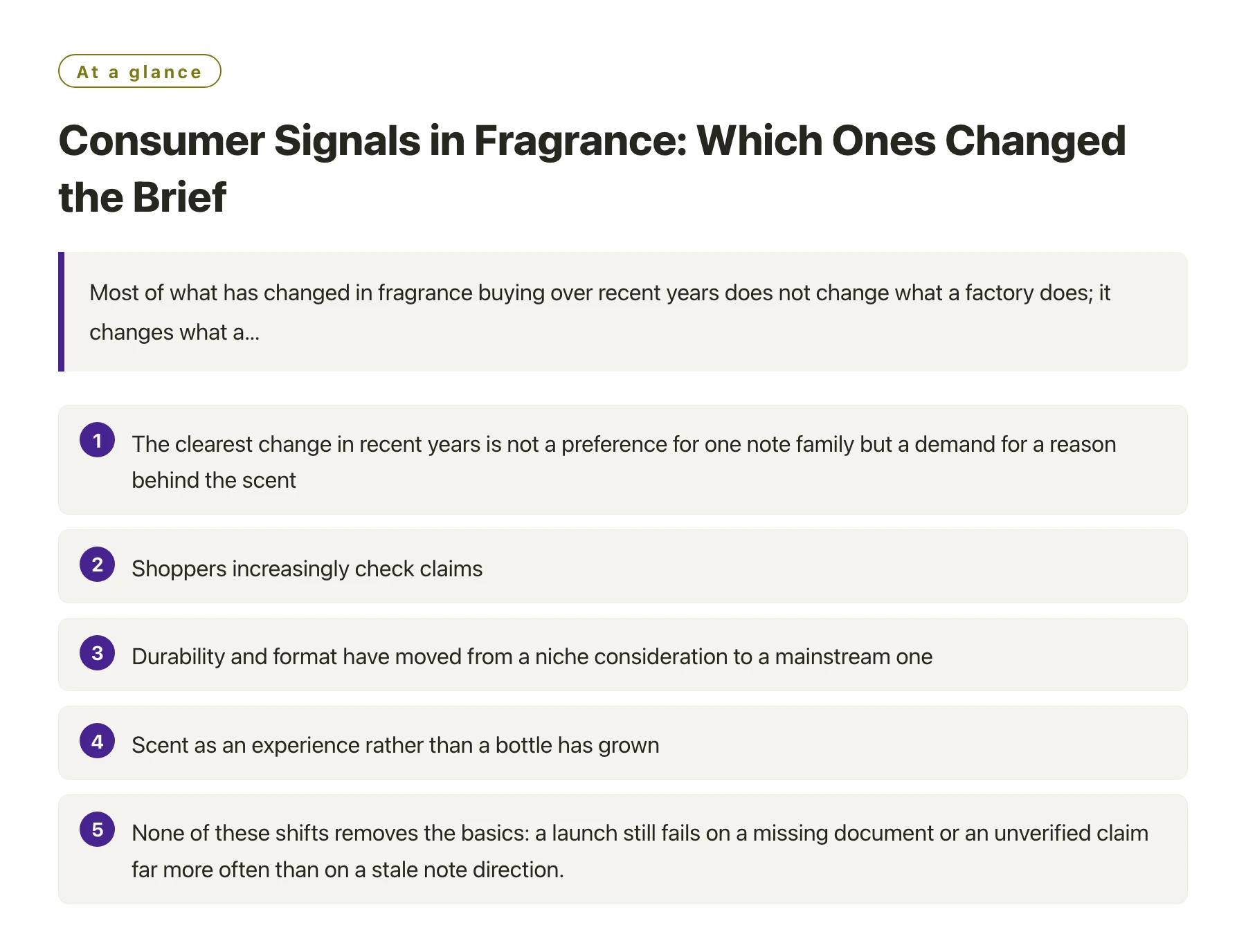
Key takeawaysThe clearest change in recent years is not a preference for one note family but a demand for a reason behind the scent, which pushes brands to brief a story as well as a smell. · Shoppers increasingly check claims, so a launch that says clean, refillable or natural now needs documents that survive a question rather than a slogan that survives a glance. · Durability and format have moved from a niche consideration to a mainstream one, which changes pack choice earlier in the project than it used to. · Scent as an experience rather than a bottle has grown, which creates demand for formats beyond fine fragrance and for suppliers who can handle more than one product type. · None of these shifts removes the basics: a launch still fails on a missing document or an unverified claim far more often than on a stale note direction.
Trend decks arrive every season with the same structure: a handful of cultural observations, a colour palette, and a note family presented as the answer to the next two years. They can be genuinely useful for direction, and they are almost useless for planning production.
The more practical question for anyone preparing an EU-bound launch is which observed shifts have already changed how buyers behave in a meeting with a supplier. A trend that only changes a mood board is a marketing decision. A trend that changes what a buyer asks for in writing is a sourcing decision, and those are the ones worth carrying into the brief.
This piece is written from a product development seat, where the useful output of a trend review is a short list of decisions: which format, which evidence, which calendar, and which supplier capability has to exist before the project can start.
Three shifts that changed the brief, not just the copy
The first shift is the demand for a reason. A scent that exists because the brand liked it is a harder sell than it was a decade ago, both to retail buyers and to shoppers who read the product page. In practice this means the fragrance brief now carries a short narrative as well as a direction, and the perfumer is asked to justify a material choice against that narrative. Suppliers who develop scents in-house handle this comfortably because the discussion happens before the formula is fixed.
The second shift is verification. Categories that once sold on aspiration now sell on claims, and each claim carries evidence. Fragrance houses and market researchers have both documented a consumer that compares labels and reads ingredient lists before buying, and the reporting from the sector suggests this behaviour survived the end of the pandemic rather than fading with it [1]. For a brand, the practical consequence is that the evidence pack has to exist before the campaign copy is written, not after.
The third shift is the afterlife of the product. Refills, concentrates, recyclable components and smaller formats have moved from a positioning idea to a design constraint. That constraint reaches the factory early, because replacing a pump, changing a glass weight or moving to a refillable shell alters filling, compatibility testing and pack qualification.
How a signal becomes a line in a brief
A trend only becomes real for a factory when it is translated into something measurable. Consider the interest in lighter, more transparent compositions: as a mood it is vague, but as a brief line it becomes a target for top-note prominence, a limit on the sweetness of the base, and a request for performance testing on skin.
Transparency of sourcing works the same way. A brand that wants to tell a material story needs the supplier to know which materials are traceable and which are not. That is a question about the perfumery house's documentation, and it belongs in the supplier evaluation rather than in the marketing plan.
Experience-led retail has produced a different translation. Brands that plan a physical moment, a pop-up, a guided tasting or a dedicated space need formats that can be demonstrated without a sale, and sometimes a second product type such as a home or body item. Some take their cue from the immersive scent museum, where a visitor meets materials and accords before meeting a product. That broadens the capability question from filling a bottle to running a mixed portfolio, which is a useful filter when shortlisting partners.
Consumer interest in scent as culture has also made the story of a house more visible, and cultural institutions have become part of how fragrance is presented to the public, from exhibitions to guided collections in museums [2]. This sits inside the same movement as the rise of Chinese fragrance brands into international retail. A brand planning an experience-led launch can borrow that language, but the operational lesson is narrower: the experience has to be supported by a production plan, not the other way round.
What has not changed, and why that is the useful part
The basic failure modes of a launch are remarkably stable. A formula that was never tested in the actual pack, a label that omits a required allergen, a batch that drifts from the approved sample, a supplier that cannot produce the file when a distributor asks for it. None of these are trend problems and none of them are solved by a better mood board.
This is why the most reliable reading of consumer signals is defensive. If shoppers are more willing to question a claim, the brand that has organised its documents will look credible and the one that has not will look evasive, regardless of the scent. Trend awareness tells you what to sell; document discipline decides whether you are allowed to sell it.
It also helps to resist the idea that every shift requires a new supplier. Most of the changes described here are absorbed inside an existing relationship if the partner operates as a custom fragrance development partner rather than an order taker. Changing factory for every direction costs more calendar time than most launches have. It is the practical reason to look at a house such as Xuelei with development and production on one site before assuming that a change of direction requires a change of supplier.
A practical filter for any trend review: for each signal, write the sentence that would appear in the fragrance brief, then ask which document or test would prove it at the end of the project. Signals that survive both steps are worth planning around. The rest belong in a presentation, not in a production schedule.
Sources
- Mintel Press Centre —— Mintel's press releases on consumer and beauty market research, including fragrance and personal care trend reporting.
- Cosmetics Business —— A trade publication covering the beauty and cosmetics industry, including fragrance launches and regulatory developments.
Frequently asked questions
Which consumer change has affected fragrance sourcing the most?
The willingness to check a claim. It moves documents and testing from a launch formality to an item on the project plan, because a claim that cannot be evidenced is a commercial risk rather than a marketing weakness.
Do trend shifts mean brands should change suppliers more often?
Rarely. A partner that can develop a formula, adjust a pack and produce the technical file absorbs most direction changes without a new onboarding cycle, which is usually faster and cheaper than switching.
How early should a format decision be made?
Before the formula is fixed where possible. Format affects dosage, compatibility and pack qualification, so deciding it late forces rework on tests that had already been paid for.
Is a story-led scent brief harder for a factory?
It is harder to do well if the factory only fills orders, and routine if it develops scents in-house. The extra work is a short conversation about materials, not a longer development calendar.
What signal should a first-time founder ignore?
Any signal that cannot be translated into a decision the factory can act on. If a trend does not change the format, the evidence, the calendar or the capability list, it will not change the outcome of the launch.